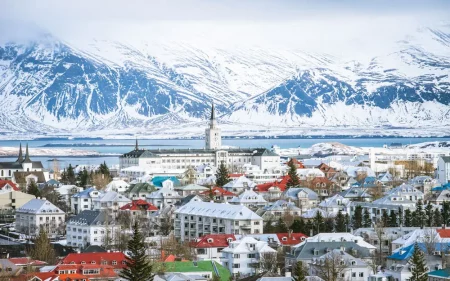
Cheapest universities in Iceland
Iceland is home to several higher education institutions that provide a high-quality education at a low cost. Given the country’s breathtaking scenery, it’s no surprise that more and more students are flocking to Iceland. If you’re one of these prospective students, make sure to check out this list of affordable universities in Iceland for international students.
List of Cheap Universities in Iceland
1. University of Iceland
Fees for Undergraduate Programs: Only ISK 75,000 ($585) each year for the registration.
Graduate Programs: Tuition Fee: Cheap university in Iceland
Iceland is home to several higher education institutions that provide a high-quality education at a low cost. Given the country’s breathtaking scenery, it’s no surprise that more and more students are flocking to Iceland. If you’re one of these prospective students, make sure to check out this list of affordable universities in Iceland for international students.
The University of Iceland is the country’s oldest and largest higher education institution, having been established in 1911. Previously a servants’ school, the Reykjavik-based university today has 8,309 students, with 12 percent of them hailing from different countries throughout the world.
2. University of Akureyri
Undergraduate Programs: Tuition Fee: The annual registration price is merely ISK 75,000 ($585).
Graduate Programs: Tuition Fee: The annual registration price is merely ISK 75,000 ($585).
Tuition Fees for Undergraduates https://www.unak.is/english/study/application/registration-fee
The University of Akureyri, located in northern Iceland, is the region’s leading provider of distance education. It was founded in 1987 and collaborates with several colleges to give specific programs.
Foreign students can pick from several bachelor’s programs in Social Sciences, Education, Law, Occupational Therapy, Nursing, Business Administration, and Natural Resource Science at the University of Akureyri. Graduate degrees in law, education, and natural resource studies are also available.
3. Agricultural University of Iceland
Undergraduate Programs: Tuition Fee: The annual registration price is merely ISK 75,000 ($585).
Graduate Programs: Tuition Fee: The annual registration price is merely ISK 75,000 ($585).
http://www.lbhi.is
Another inexpensive university in Iceland is the Agricultural University of Iceland, which is part of the NOVA network. It is one of Iceland’s newest institutions, having only been established in 2005.
Despite its youth, AUI specializes in disciplines that are not offered at most colleges. Agriculture, Equine Science, Natural & Environmental Science, Forest Science, and Landscape Architecture are among the undergraduate programs available.
Master’s degrees in Planning and Environmental Changes are also available at AUI.
4. Hólar University College
Undergraduate Programs: Tuition Fee: The annual registration price is merely ISK 75,000 ($585).
Graduate Programs: Tuition Fee: The annual registration price is merely ISK 75,000 ($585).
Hólar University College is the next affordable university in Iceland on our list. It is one of Europe’s oldest institutions, having been founded in 1106 as a cathedral school. It was later called Hólar Agricultural College before being given its current name in 2007.
https://english.hi.is
The University of Iceland is the country’s oldest and largest higher education institution, having been established in 1911. Previously a servants’ school, the Reykjavik-based university today has 8,309 students, with 12 percent of them hailing from different countries throughout the world.
2. University of Akureyri
Undergraduate Programs: Tuition Fee: The annual registration price is merely ISK 75,000 ($585).
Graduate Programs: Tuition Fee: The annual registration price is merely ISK 75,000 ($585).
Tuition Fees for Undergraduates https://www.unak.is/english/study/application/registration-fee
The University of Akureyri, located in northern Iceland, is the region’s leading provider of distance education. It was founded in 1987 and collaborates with several colleges to give specific programs.
Foreign students can pick from several bachelor’s programs in Social Sciences, Education, Law, Occupational Therapy, Nursing, Business Administration, and Natural Resource Science at the University of Akureyri. Graduate degrees in law, education, and natural resource studies are also available.
3. Agricultural University of Iceland
Undergraduate Programs: Tuition Fee: The annual registration price is merely ISK 75,000 ($585).
Graduate Programs: Tuition Fee: The annual registration price is merely ISK 75,000 ($585).
http://www.lbhi.is/study Maui/undergraduate tuition fee
Another inexpensive university in Iceland is the Agricultural University of Iceland, which is part of the NOVA network. It is one of Iceland’s newest institutions, having only been established in 2005.
Despite its youth, AUI specializes in disciplines that are not offered at most colleges. Agriculture, Equine Science, Natural & Environmental Science, Forest Science, and Landscape Architecture are among the undergraduate programs available.
Master’s degrees in Planning and Environmental Changes are also available at AUI.
4. Hólar University College
Undergraduate Programs: Tuition Fee: The annual registration price is merely ISK 75,000 ($585).
Graduate Programs: Tuition Fee: The annual registration price is merely ISK 75,000 ($585).
Hólar University College is the next affordable university in Iceland on our list. It is one of Europe’s oldest institutions, having been founded in 1106 as a cathedral school. It was later called Hólar Agricultural College before being given its current name in 2007.
Studying in Iceland on a budget — what the fees above actually mean
Tuition is only one line in the budget, and on its own it is a poor guide to whether you can afford to study in Iceland. A country with low tuition and high living costs can end up more expensive than one with higher tuition and cheap accommodation. Work out the total annual cost before you compare anywhere.
How to check a tuition figure before you rely on it
Fee figures on any website — including this one — go out of date. Universities revise tuition annually, and governments change policy. Before you rely on a number:
- Open the university’s own website and find the fees page for international or non-national students. That is the only figure that counts.
- Check the academic year the figure applies to. A 2023 fee table tells you very little about what you will pay in 2026/2027.
- Confirm whether the price is per year, per semester or per credit. Per-credit pricing is common and makes cheap-looking programmes expensive.
- Check whether international students pay a different rate. In many systems local and EU students pay far less than everyone else.
- Email the admissions office and keep the reply. A written quote protects you.
A live example of why this matters: Norway’s public universities were free for everyone until 2023, when parliament introduced cost-covering fees for non-EU/EEA students — and non-European enrolment fell by roughly 80% within two years. In June 2025 the government proposed letting institutions set their own fees again, including at zero, from August 2026. Anyone relying on a five-year-old “tuition-free” article would have got it badly wrong in both directions.
Entry route: Iceland is in the Schengen area, so you will apply for a national long-stay student visa (type D) at the embassy or an accredited visa centre in Abuja or Lagos, not a short-stay Schengen visa. Expect to show an admission letter, proof of funds in a blocked or verifiable account, health insurance and accommodation. A major advantage: once you hold a residence permit you can travel across the Schengen area.
Language of instruction: Iceland offers a substantial number of degree programmes taught entirely in English, particularly at master’s level. Undergraduate teaching is more often in the local language. An English test is usually required, though some institutions waive it where your previous degree was taught in English. Confirm both the programme language and the waiver policy in writing before applying.
Build a realistic total-cost budget
Before applying to any institution in Iceland, price all of the following. Applicants routinely underestimate the second half of this list:
- Tuition for international students, for the correct academic year
- Application and acceptance fees, which are usually non-refundable
- Accommodation — on-campus versus private rent can differ enormously
- Living costs — food, transport, data, utilities
- Health insurance, which is compulsory in most study destinations
- Visa or permit fees, plus biometrics and courier charges
- Flights, and a return flight if the visa requires proof of one
- Proof of funds — money you must show you hold, on top of what you actually spend
- Document costs — transcripts, notarisation, apostille, translation, courier
- The naira exchange rate, and how a further depreciation would affect year two
How to bring the cost down honestly
- Apply for scholarships in parallel, not afterwards. Most funding deadlines fall before or alongside admission deadlines, not after.
- Look at government scholarships from Iceland itself. Many countries fund international students directly, and these are often less competitive than the famous named awards.
- Ask about assistantships and tuition waivers at postgraduate level. Teaching or research assistantships can cut or eliminate tuition.
- Ask about fee instalments. Many institutions allow termly payment, which matters when you are converting naira.
- Check student work rights on your visa — how many hours, and whether you may work at all. Never plan a budget that depends on illegal work.
- Compare smaller cities. Rent outside the capital is often the single biggest saving available.
A warning about agents
No agent can guarantee you admission or a visa. If someone promises either in exchange for money, walk away. Legitimate agents are paid by institutions, publish their registration details, and will never ask you to send money to a personal account. Apply directly to the university wherever you can — almost every institution accepts direct applications, and it is free or cheaper.
Frequently asked questions
Can Nigerians study in Iceland?
Yes. Nigerian students are admitted to institutions in Iceland subject to meeting the academic entry requirements, the language requirement and the immigration rules set out above.
Is the cheapest university the best choice?
Not automatically. Check that the institution is recognised by the national regulator in Iceland and, if you plan to return home or move on, that its degrees are accepted where you intend to work. A cheap degree from an unrecognised institution costs you everything.
Do I need IELTS to study in Iceland?
It depends on the programme and the institution. Where teaching is in English, many institutions waive the test for applicants whose previous degree was taught in English — which covers most Nigerian graduates. Always confirm in writing before paying for a test.
How much money do I need to show?
That is set by the immigration authorities, not the university, and it changes. Check the official government source for Iceland shortly before you apply, because the figure is usually updated annually.
Can I work while studying?
Some countries permit limited part-time work on a student visa and some do not. Confirm the rule for your specific visa type, and treat any earnings as a supplement rather than the basis of your budget.
Related guides
- Full list of universities in Iceland
- International scholarships for Nigerians
- Best scholarships for Nigerians and Africans
- More study-abroad and scholarship guides
Tuition fees, visa rules and proof-of-funds thresholds change every year. Always confirm the current figures on the official university and government websites for Iceland before you apply or pay anything.