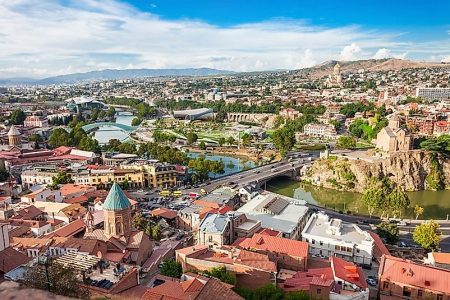
Cheapest Universities in Georgia
When you hear the word “Georgia,” you’re probably thinking of a U.S. city, but there’s a small part of the world with lovely traditions with the same name. Georgia is a small country in the Caucasus area with a population of around 3.7 million people (Eurasia). It was a component of the Soviet Union until its disintegration in 1991 when it declared independence.
Georgia’s universities provide bachelor’s degrees (between 180 and 240 credits, or three to four years), master’s degrees (120 credits, or two years), and doctorate degrees (between 120 and 240 credits, or three to four years) (180 credits or three years). Longer programs, such as medicine or veterinary medicine, require between 300 and 360 credits to complete.
Cheapest Universities in Georgia
1. Georgian Technical University http://gtu.ge/Eng/
Georgian Technical University is the country’s first low-cost university. This university began as a faculty of another institution, Tbilisi State University of Georgia (TSU). In 1928, it became self-governing, and in 990, it was granted university status.
Mines and geology, informatics and control systems, chemical technology and metallurgy, transportation and machine building, power engineering and telecommunications, civil engineering, social and humanities, and architecture, urban planning, and design are among the eight faculties.
This is the most important university in the technical field. In recent years, it has educated 60% of the country’s scientists and engineers.
The English program costs 9,000 GEL (about 3,100 USD), the Russian program costs 3,500 GEL (approximately 1,200 USD), and the Georgian program costs 2,250 GEL (approximately 800 USD).
2. Shota Rustaveli State University https://bsu.edu.ge
Shota Rustaveli State University, which was founded almost 80 years ago, is located in Batumi. Education, law, humanities, business and economics, social and political sciences, physics, mathematics, computer sciences, natural sciences and healthcare, technology, and tourism are among the nine faculties.
There are approximately 6,000 students enrolled in one of the 43 bachelor’s degree programs. In addition, 28 master’s degree programs, 15 doctorate degree programs, and three research institutions are available.
Bachelor’s degree programs cost 2,250 GEL (about 800 USD) intuition. As a result, Shota Rustaveli State University is regarded as a low-cost university in Georgia. The majority of the programs, however, are taught in Georgia.
3. Tbilisi State Academy of Arts http://art.edu.ge/acge/index.htm
For individuals who desire to devote their lives to the arts, the Tbilisi State Academy of Arts is ideal. In all disciplines of design and architecture, there are numerous specialties.
Fine arts, design, media arts, visual arts, architecture and restoration, art history, and theory are all offered at this cheap institution in Georgia.
Both bachelor’s and master’s degrees have tuition costs of 2,250 GEL (about 800 USD).
Studying in Georgia on a budget — what the fees above actually mean
Tuition is only one line in the budget, and on its own it is a poor guide to whether you can afford to study in Georgia. A country with low tuition and high living costs can end up more expensive than one with higher tuition and cheap accommodation. Work out the total annual cost before you compare anywhere.
How to check a tuition figure before you rely on it
Fee figures on any website — including this one — go out of date. Universities revise tuition annually, and governments change policy. Before you rely on a number:
- Open the university’s own website and find the fees page for international or non-national students. That is the only figure that counts.
- Check the academic year the figure applies to. A 2023 fee table tells you very little about what you will pay in 2026/2027.
- Confirm whether the price is per year, per semester or per credit. Per-credit pricing is common and makes cheap-looking programmes expensive.
- Check whether international students pay a different rate. In many systems local and EU students pay far less than everyone else.
- Email the admissions office and keep the reply. A written quote protects you.
A live example of why this matters: Norway’s public universities were free for everyone until 2023, when parliament introduced cost-covering fees for non-EU/EEA students — and non-European enrolment fell by roughly 80% within two years. In June 2025 the government proposed letting institutions set their own fees again, including at zero, from August 2026. Anyone relying on a five-year-old “tuition-free” article would have got it badly wrong in both directions.
Entry route: Georgia is outside the EU and issues its own student visa. Requirements usually include an admission letter, proof of funds, health insurance and legalised or apostilled academic documents. Because Georgia is outside the Schengen zone, a residence permit there does not give you free movement into EU countries.
Language of instruction: most degree programmes in Georgia are taught in the local language, with a smaller selection available in English — usually at postgraduate level. Check the language of instruction for your specific programme before anything else, because this single detail rules out more applicants than tuition cost does. Where an English-taught programme exists, ask whether an IELTS or TOEFL waiver applies to Nigerian degree holders.
Build a realistic total-cost budget
Before applying to any institution in Georgia, price all of the following. Applicants routinely underestimate the second half of this list:
- Tuition for international students, for the correct academic year
- Application and acceptance fees, which are usually non-refundable
- Accommodation — on-campus versus private rent can differ enormously
- Living costs — food, transport, data, utilities
- Health insurance, which is compulsory in most study destinations
- Visa or permit fees, plus biometrics and courier charges
- Flights, and a return flight if the visa requires proof of one
- Proof of funds — money you must show you hold, on top of what you actually spend
- Document costs — transcripts, notarisation, apostille, translation, courier
- The naira exchange rate, and how a further depreciation would affect year two
How to bring the cost down honestly
- Apply for scholarships in parallel, not afterwards. Most funding deadlines fall before or alongside admission deadlines, not after.
- Look at government scholarships from Georgia itself. Many countries fund international students directly, and these are often less competitive than the famous named awards.
- Ask about assistantships and tuition waivers at postgraduate level. Teaching or research assistantships can cut or eliminate tuition.
- Ask about fee instalments. Many institutions allow termly payment, which matters when you are converting naira.
- Check student work rights on your visa — how many hours, and whether you may work at all. Never plan a budget that depends on illegal work.
- Compare smaller cities. Rent outside the capital is often the single biggest saving available.
A warning about agents
No agent can guarantee you admission or a visa. If someone promises either in exchange for money, walk away. Legitimate agents are paid by institutions, publish their registration details, and will never ask you to send money to a personal account. Apply directly to the university wherever you can — almost every institution accepts direct applications, and it is free or cheaper.
Frequently asked questions
Can Nigerians study in Georgia?
Yes. Nigerian students are admitted to institutions in Georgia subject to meeting the academic entry requirements, the language requirement and the immigration rules set out above.
Is the cheapest university the best choice?
Not automatically. Check that the institution is recognised by the national regulator in Georgia and, if you plan to return home or move on, that its degrees are accepted where you intend to work. A cheap degree from an unrecognised institution costs you everything.
Do I need IELTS to study in Georgia?
It depends on the programme and the institution. Where teaching is in English, many institutions waive the test for applicants whose previous degree was taught in English — which covers most Nigerian graduates. Always confirm in writing before paying for a test.
How much money do I need to show?
That is set by the immigration authorities, not the university, and it changes. Check the official government source for Georgia shortly before you apply, because the figure is usually updated annually.
Can I work while studying?
Some countries permit limited part-time work on a student visa and some do not. Confirm the rule for your specific visa type, and treat any earnings as a supplement rather than the basis of your budget.
Related guides
- Full list of universities in Georgia
- International scholarships for Nigerians
- Best scholarships for Nigerians and Africans
- More study-abroad and scholarship guides
Tuition fees, visa rules and proof-of-funds thresholds change every year. Always confirm the current figures on the official university and government websites for Georgia before you apply or pay anything.